Who this route suits
This is the shortest way to see the Tarim and its poplars. Three days, 100 km total, one hotel for two nights in Yuli county: for travellers arriving late into Korla, or for anyone who wants a soft start before a southern Xinjiang loop. No mountain passes, no long legs, and the car stays parked for a whole day.
How the foreign vehicle comes in
The Xinjiang gateway is Horgos on the Kazakh border. Foreign vehicles must be declared to customs by a licensed agency; private cars cannot clear on their own. The service fee is 6,000 to 9,000 CNY per vehicle, covering customs declaration, border formalities, the Chinese temporary driving permit, the temporary plate (valid three months), route filing and on-site handling at the port. The customs deposit is guaranteed by us, after which the owner pays 10,000 CNY, refunded in full three to five working days after leaving China. Documents are due 20 days ahead: passport, Chinese visa, driving licence, passport photo of the driver on a white background, vehicle registration, title, engine number, and front, rear and side photos of the car; vehicles over six years old also need a roadworthiness certificate.
Route overview
| Day | Leg | Distance | Main stops |
|---|---|---|---|
| 1 | Korla – Yuli | 50 km | Lop Nur village, Tarim river, poplar forest |
| 2 | Yuli stay | - | Lop Nur village, Tarim poplars |
| 3 | Yuli – Korla | 50 km | Lower Tarim oasis, Korla |
Day by day
1 Korla to Yuli (50 km)
Lop Nur village. A rebuilt village of the Lop people on the Tarim, with timber houses, a small museum of fishing and hunting gear, and boats pulled up on the bank. Entry around 45 CNY. The winter village festival draws crowds; off-season it is quiet and you can walk the river edge alone.
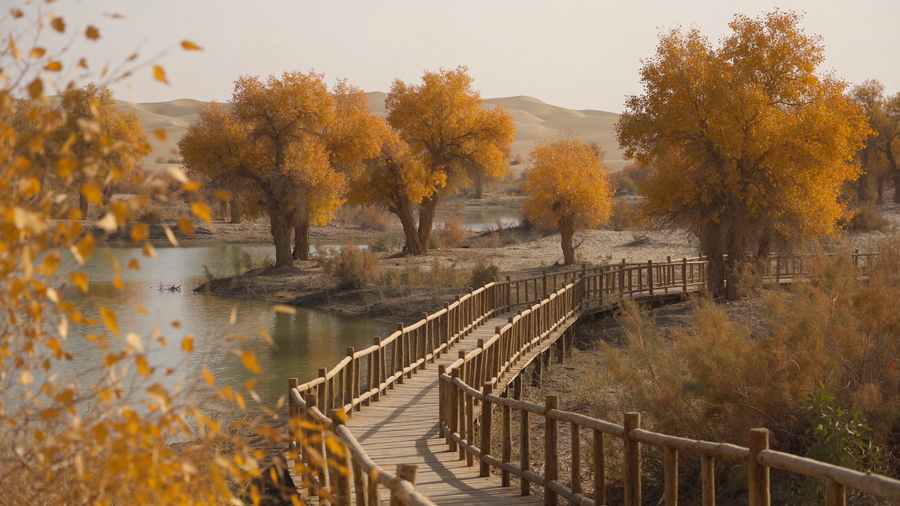
Tarim river and poplars. China's longest inland river runs past the village, lined with wild poplar that turns gold in late October. The road along the bank is paved for a stretch, then gravel; the best stands are a short walk from the parking areas.
Road note: Fifty kilometres on flat county road, an hour with stops.
Eat: Roast fish and river fish soup at the village, around 60 CNY; noodles in Yuli town, 25 CNY.
Sleep: Yuli county hotels 130 to 250 CNY; a riverside guesthouse around 200 CNY.
Tip: Fill up in Korla: the last reliable station before the river is in Yuli town.
2 Yuli stay, no driving (-)
Morning on the river. Go back to the village at opening, when the water is still and the tour buses have not arrived. The boardwalk along the bank takes an hour at a slow pace.
Afternoon in the poplars. Drive the gravel track to the second stand, where the trees are older and the ground is sand. Sunset from the low dune behind the village is the shot.
Road note: No driving: leave the car at the hotel and take a short drive only for sunset.
Eat: River fish at the village, 60 CNY; cold noodles and barbecue in Yuli, 30 CNY.
Sleep: Same hotel in Yuli, 130 to 250 CNY.
Tip: Mosquito repellent at dusk in summer; in October, a jacket for the evening.
3 Yuli back to Korla (50 km)
Lower Tarim oasis. The road back passes irrigation channels, cotton plots and a line of old poplars planted as a windbreak. Stop where the canal widens: herders water sheep there in the morning.
Korla. The Peacock River runs through the city, with a night market along it and a small mosque quarter. Good place to sort photographs and restock.
Road note: Fifty kilometres, an hour; the county road is busy with farm traffic at dusk.
Eat: Korla's Peacock River night market: grilled fish, pilaf, cold noodles, 40 to 60 CNY.
Sleep: Korla hotels 150 to 350 CNY, easy parking at the edge of the centre.
Tip: Do not drive the county road after dark in harvest season: trailers without lights.
Tickets and opening hours
| Site | Ticket | Hours |
|---|---|---|
| Lop Nur village | See ticket office | Check the gate on the day |
| Tarim river poplar forest | See ticket office | Check the gate on the day |
| Yuli county oasis | See ticket office | Check the gate on the day |
Tickets and shuttle buses are priced separately and change with season and holidays, so confirm at the gate; guides, horses and boats are extra.
Six things to know on the road
- Foreign vehicles must be declared to customs by a licensed travel agency. Private cars cannot clear the border on their own; that is the procedure, not an option.
- The temporary plate is valid three months. Do not change the route filed at entry without re-filing it.
- Some frontier districts in Xinjiang need prior approval, and Xinjiang to Tibet cannot be crossed directly: you must go around via Golmud on the G109.
- Fuel is sold against ID, so keep the vehicle registration and licence within reach; stations can be 200 km apart.
- Speed limits differ sharply between expressway and national road, and average-speed cameras are everywhere, so slow down at every sign.
- At checkpoints, slow early and hand over passport, licence, registration and temporary plate together in one folder.
When to come
October is the season: the poplars along the Tarim turn gold, the light is low and the mosquitoes are gone. April and May are green and windy. July and August are hot and humid by the river, with heavy mosquitoes at dusk. Winter is bare and quiet.
How to extend it
Add a day east to Bosten Lake for reeds and open water, or push south to the Taklamakan edge for a night in the dunes. Either extension needs a new route note, so tell us before you come.
Contact and quote
This route can be adjusted to your dates, group size and vehicle. The quote covers customs declaration, temporary plate, route filing and port handling, and excludes fuel, tickets, rooms and meals. Send the port and date you plan to enter and we will confirm what is workable under the current rules.
WhatsApp: +86 13759155671 Email: [email protected]