Who this route suits
7 days, 1950 kilometres, Kanas and Koktokay, Reversed. The route strings together Gurbantonggut Desert, Kalamaili Reserve, Fuhai and Ulungur Lake, Altay Grasslands, Hemu River, Kanas Lake without long days behind the wheel. Three to five hours a day, with one or two full days without moving, for couples or two or three friends who would rather unpack once and see a region properly.
How the foreign vehicle comes in
The Xinjiang gateway is Horgos on the Kazakh border. Foreign vehicles must be declared to customs by a licensed agency; private cars cannot clear on their own. The service fee is 6,000 to 9,000 CNY per vehicle, covering customs declaration, border formalities, the Chinese temporary driving permit, the temporary plate (valid three months), route filing and on-site handling at the port. The customs deposit is guaranteed by us, after which the owner pays 10,000 CNY, refunded in full three to five working days after leaving China. Documents are due 20 days ahead: passport, Chinese visa, driving licence, passport photo of the driver on a white background, vehicle registration, title, engine number, and front, rear and side photos of the car; vehicles over six years old also need a roadworthiness certificate.
Route overview
| Day | Leg | Distance | Main stops |
|---|---|---|---|
| 1 | Urumqi—Fuyun | 480 km | Gurbantonggut Desert, Kalamaili Reserve |
| 2 | Fuyun—Altay | 330 km | Fuhai and Ulungur Lake, Altay Grasslands |
| 3 | Altay—Hemu | 270 km | Altay Grasslands, Hemu River |
| 4 | Hemu—Kanas | 70 km | Hemu River, Kanas Lake |
| 5 | Kanas—Burqin | 150 km | Burqin Town, The Three Bays |
| 6 | Burqin—Karamay | 330 km | Urho Ghost City, Karamay Oil Field |
| 7 | Karamay—Urumqi | 320 km | Karamay Oil Field, Desert Highway Sections |
Day by day
1 Urumqi to Fuyun (480 km)
Gurbantonggut Desert. Gurbantonggut is China's second largest desert, filling the middle of the Junggar basin. Unlike the Taklamakan in the south, most of its dunes are fixed, held by saxaul, camelthorn and short-lived spring plants that green the sand after the thaw and sometimes flower in May. The Kalamaili ungulate reserve lies along its eastern edge, where wild asses and goitered gazelles occasionally show. Stretches of the G216 and G217 run straight through, dunes on both sides, so there is no need to enter a scenic area. Winds are strong here and can push the car sideways, so keep both hands on the wheel; at midday in summer the ground is fiercely hot, so check tyre pressures before setting out.
Kalamaili Reserve. The largest ungulate reserve in Xinjiang, on the eastern Junggar basin, where wild asses, gazelles and argali run across open desert and herds sometimes cross the highway. Warning signs line the reserve edge; slow down and never sound the horn at animals. Fuel stations are far apart, so carry water and fill up. Summer is brutally hot, winter brings snow, spring and autumn are the best seasons.
Road note: Four to six hours on the road. Start early, fill up at half a tank, and avoid the two hottest midday hours.
Eat: Banmian and grilled meat in town, around 40 CNY.
Sleep: Rooms 150 to 300 CNY.
Tip: Koktokay is fifty kilometres of winding mountain road, so take it slow.
This is day one of a foreign vehicle self-drive Xinjiang trip, so fill the tank before leaving town: stations sit further apart than they look on the map.
Back at the finish the foreign vehicle self-drive Xinjiang loop closes, so settle tomorrow's direction the night before.
2 Fuyun to Altay (330 km)
Fuhai and Ulungur Lake. Xinjiang's second-largest lake, over a thousand square kilometres of water just outside Fuhai town, known locally as the Big Sea. The east shore has sand, reeds and a few resorts; grilled cold-water fish at the lakeside restaurants costs around 100 CNY. The smaller Jili Lake to the west is shallower and thick with reeds and birds. It is a little over 100 km from Altay on good road. Wind is strong and constant, so pick a sheltered camp site.
Altay Grasslands. The northernmost summer pasture belt in Xinjiang, spread along the roads out of Altay towards Fuyun and Burqin. Grass does not green up until June and peaks in July and August, with sheep and horse herds scattered across the slopes and the Altai snow line behind. Nothing is fenced off; the scenery is the road itself. Farm tracks are open but do not drive on pasture or chase stock. Mobile signal is patchy, so download offline maps.
Road note: Four to six hours on the road. Start early, fill up at half a tank, and avoid the two hottest midday hours.
Eat: Boiled lamb, milk tea and cold-water fish, around 60 CNY.
Sleep: Rooms 150 to 350 CNY.
Tip: Fuyun is 330 km with few services, so start with a full tank.
For a foreign vehicle self-drive Xinjiang drive, today is the easiest road of the trip and the right place to get used to the limits.
3 Altay to Hemu (270 km)
Altay Grasslands, second visit. Skip the full boardwalk this time and pick the section you missed; the light and the crowds will be different anyway.
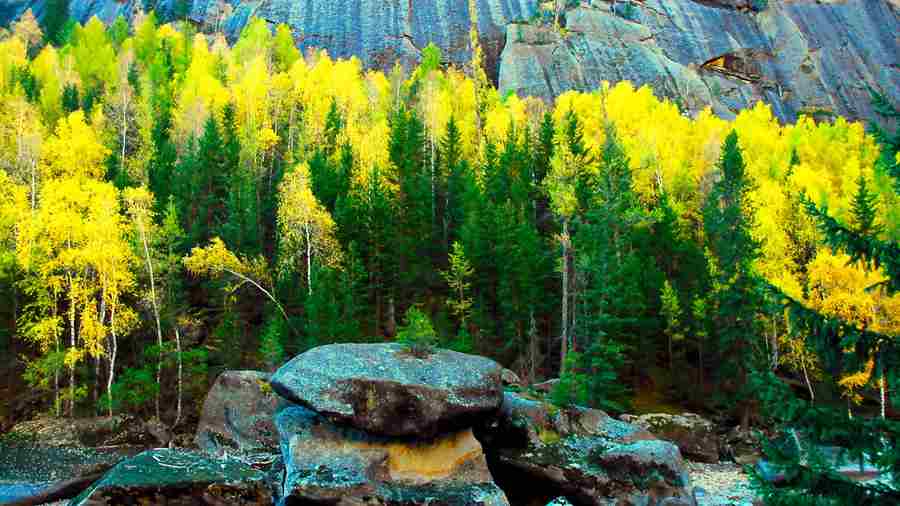
Hemu River. Glacial meltwater runs straight through the village, cold even in August, over a bed of rounded stones. The riverside boardwalk reaches Hemu Bridge in about twenty minutes, and the bridge is the classic angle: birch on one bank, spruce on the other, both turning gold in late September and October. A few stalls sell grilled fish and milk tea. The track deeper towards Meili Peak is rough and not for sedans.
Road note: Two or three hours of driving with service areas and towns in between, so there is no need to rush.
Eat: Village restaurants serve boiled lamb and milk tea at 60 to 80 CNY.
Sleep: Dorm beds from 100 CNY, log guesthouses 500 to 800 CNY, scarce in season.
Tip: Cars cannot enter the village; nights are cold even in September.
On a foreign vehicle self-drive Xinjiang route, watch the gauge here; the next station can be two hundred kilometres on.
4 Hemu to Kanas (70 km)
Hemu River, second visit. Skip the full boardwalk this time and pick the section you missed; the light and the crowds will be different anyway.
Kanas Lake. A glacier-dammed lake at 1,300 m in the Altai, twenty-four kilometres long and over 180 m deep in places. The water shifts from milky blue in sun to grey-green under cloud, fullest in June. The lakeside boardwalk runs from the outlet to the first bay in about an hour, nearly flat. A boat to the lake centre costs around 120 CNY for forty minutes. Even in July the shore sits near 20 C with wind.
Road note: A short day on paved road, under an hour, with stops whenever you like.
Eat: Food inside the reserve is expensive, 40 to 50 CNY for a bowl of noodles, so eat well in Burqin.
Sleep: Jiadengyu 300 to 800 CNY, Hemu 200 to 700 CNY.
Tip: Ticket plus shuttle is 230 CNY and valid two days; staying inside is the only way to be early.
The second half of today is where a foreign vehicle self-drive Xinjiang journey gets careless: the road looks flat, but the bends hide behind rises.
5 Kanas to Burqin (150 km)
Burqin Town. The last proper town before Kanas, sitting on the Irtysh River. The embankment night market is the local institution: grilled cold-water fish, lamb ribs, kvass and yoghurt, open past midnight, around 70 to 80 CNY per person. Hotels range from 100 to 600 CNY, far cheaper than inside the reserve. It is about 150 km and two and a half hours to the Kanas gate, so fill the tank here because stations thin out in the mountains.
The Three Bays. Wolong Bay, Moon Bay and Shenxian Bay are three bends of the Kanas River, each with a shuttle stop. Wolong has a wide pool with a sandbar in the middle and a short path down to the water. Moon Bay is the photogenic one, a crescent peninsula wrapped by blue-green water, seen straight from the roadside platform with no walking. Shenxian Bay holds fog until about eight in the morning. Walking the whole boardwalk takes two hours downhill.
Road note: Two or three hours of driving with service areas and towns in between, so there is no need to rush.
Eat: Cold-water fish, lamb ribs and kvass at the riverside night market, around 80 CNY.
Sleep: Rooms 150 to 600 CNY with plenty of choice.
Tip: Fill up before the mountains and keep an eye on your belongings in the market.
By this stage of a foreign vehicle self-drive Xinjiang itinerary the car and the driver have settled in, which is exactly when people start pushing the speed.
6 Burqin to Karamay (330 km)
Urho Ghost City. A yardang field about 100 km north of Karamay, eroded into castles, mushrooms and beasts across tens of kilometres, where wind through the gullies makes the whistling that gave the place its name. A tourist train loops four or five stops in ninety minutes, and boardwalks link the viewpoints. The last hour before sunset turns the rock red and stretches the shadows. Summer midday hits 50 C with sand-laden wind, so protect cameras.
Karamay Oil Field. China's first big oilfield, and the road north to Urho runs between pumpjacks packed to the horizon, which is what people mean by the Hundred-Mile Oilfield. By day it is pure industry; after sunset the jacks nod in rows against a desert sky and it becomes one of the more unexpected sights in Xinjiang. Pull-offs exist along the highway. Do not leave the road inside the field; well pads and pipelines are off limits.
Road note: Four to six hours on the road. Start early, fill up at half a tank, and avoid the two hottest midday hours.
Eat: Big-plate chicken and roasted lamb ribs, around 60 CNY.
Sleep: Clean rooms 200 to 400 CNY.
Tip: Urho is 100 km north and the oilfield enforces strict speed limits.
Today is the day to slow a foreign vehicle self-drive Xinjiang trip down: pull over wherever you can, since the best views sit beyond the lay-bys.
7 Karamay to Urumqi (320 km)
Karamay Oil Field, second visit. Skip the full boardwalk this time and pick the section you missed; the light and the crowds will be different anyway.
Desert Highway Sections. The Gobi in Xinjiang is less a landscape than a scale: hundreds of kilometres with no tree, water or settlement, a straight horizon and most of the frame given to sky. Prepare properly: fill up at half a tank, carry three litres of water per person per day, and avoid the two hottest midday hours. Mirage makes the road look wet. Dust storms cut visibility fast, so slow down or stop.
Road note: Four to six hours on the road. Start early, fill up at half a tank, and avoid the two hottest midday hours.
Eat: Urumqi has the widest choice of restaurants in Xinjiang, from banmian noodles to big-plate chicken, around 50 CNY per person.
Sleep: Hotels run 150 to 500 CNY with easy parking.
Tip: Rush hour is heavy; fill the tank before leaving the city.
Halfway round this foreign vehicle self-drive Xinjiang loop, check tyre pressure and washer fluid before the long legs ahead.
Tickets and opening hours
| Site | Ticket | Hours |
|---|---|---|
| Gurbantonggut Desert | See ticket office | Check the gate on the day |
| Kalamaili Reserve | See ticket office | Check the gate on the day |
| Fuhai and Ulungur Lake | See ticket office | Check the gate on the day |
| Altay Grasslands | See ticket office | Check the gate on the day |
| Hemu River | See ticket office | Check the gate on the day |
| Kanas Lake | See ticket office | Check the gate on the day |
| Burqin Town | See ticket office | Check the gate on the day |
| The Three Bays | See ticket office | Check the gate on the day |
| Urho Ghost City | See ticket office | Check the gate on the day |
| Karamay Oil Field | See ticket office | Check the gate on the day |
| Desert Highway Sections | See ticket office | Check the gate on the day |
Tickets and shuttle buses are priced separately and change with season and holidays, so confirm at the gate; guides, horses and boats are extra.
Six things to know on the road
- Foreign vehicles must be declared to customs by a licensed travel agency. Private cars cannot clear the border on their own; that is the procedure, not an option.
- The temporary plate is valid three months. Do not change the route filed at entry without re-filing it.
- Some frontier districts in Xinjiang need prior approval, and Xinjiang to Tibet cannot be crossed directly: you must go around via Golmud on the G109.
- Fuel is sold against ID, so keep the vehicle registration and licence within reach; stations can be 200 km apart.
- Speed limits differ sharply between expressway and national road, and average-speed cameras are everywhere, so slow down at every sign.
- At checkpoints, slow early and hand over passport, licence, registration and temporary plate together in one folder.
When to come
For Kanas and Hemu, June is green and late September to early October is the birch peak, which is also the busiest and most expensive window. July is wet, and from late October snow closes the high sections. Mid-June and late August are the two quieter gaps.
How to extend it
The simplest extension is one more night at Gurbantonggut Desert, so the next day needs no driving and you can add a side valley or village. With two or three more days you could add a stretch towards Ili or Kanas; any change of route needs re-filing.
Contact and quote
This route can be adjusted to your dates, group size and vehicle. The quote covers customs declaration, temporary plate, route filing and port handling, and excludes fuel, tickets, rooms and meals. Send the port and date you plan to enter and we will confirm what is workable under the current rules.
WhatsApp: +86 13759155671 Email: [email protected]