Who this route suits
9 days, 2080 kilometres, Koktokay, Kanas and Tianchi In Depth. The route strings together Gurbantonggut Desert, Kalamaili Reserve, Kekesuli, Irtysh River, Pit No. 3, Altay Grasslands without long days behind the wheel. Three to five hours a day with several full stops, for travellers with enough holiday to spend an extra night where the light is good, and for owners who want to cover the north or the south in one run.
How the foreign vehicle comes in
The Xinjiang gateway is Horgos on the Kazakh border. Foreign vehicles must be declared to customs by a licensed agency; private cars cannot clear on their own. The service fee is 6,000 to 9,000 CNY per vehicle, covering customs declaration, border formalities, the Chinese temporary driving permit, the temporary plate (valid three months), route filing and on-site handling at the port. The customs deposit is guaranteed by us, after which the owner pays 10,000 CNY, refunded in full three to five working days after leaving China. Documents are due 20 days ahead: passport, Chinese visa, driving licence, passport photo of the driver on a white background, vehicle registration, title, engine number, and front, rear and side photos of the car; vehicles over six years old also need a roadworthiness certificate.
Route overview
| Day | Leg | Distance | Main stops |
|---|---|---|---|
| 1 | Urumqi—Fuyun | 480 km | Gurbantonggut Desert, Kalamaili Reserve |
| 2 | Fuyun—Koktokay | 50 km | Kekesuli, Irtysh River, Pit No. 3 |
| 3 | Koktokay—Burqin | 380 km | Altay Grasslands, Fuhai and Ulungur Lake |
| 4 | Burqin—Kanas | 150 km | Jiadengyu, The Three Bays, Kanas Lake |
| 5 | Kanas—Hemu | 70 km | Hemu River, Birch Groves, Hemu Village |
| 6 | Hemu—Burqin | 160 km | Hemu Viewing Platform, Grassland Sections |
| 7 | Burqin—Urho | 230 km | Irtysh River, Urho Ghost City |
| 8 | Urho—Urumqi | 420 km | Karamay Oil Field |
| 9 | Urumqi—Tianchi Lake—Urumqi | 140 km | Heavenly Lake, Dingshen Zhen, East Small Heavenly Lake |
Day by day
1 Urumqi to Fuyun (480 km)
Gurbantonggut Desert. Gurbantonggut is China's second largest desert, filling the middle of the Junggar basin. Unlike the Taklamakan in the south, most of its dunes are fixed, held by saxaul, camelthorn and short-lived spring plants that green the sand after the thaw and sometimes flower in May. The Kalamaili ungulate reserve lies along its eastern edge, where wild asses and goitered gazelles occasionally show. Stretches of the G216 and G217 run straight through, dunes on both sides, so there is no need to enter a scenic area. Winds are strong here and can push the car sideways, so keep both hands on the wheel; at midday in summer the ground is fiercely hot, so check tyre pressures before setting out.
Kalamaili Reserve. The largest ungulate reserve in Xinjiang, on the eastern Junggar basin, where wild asses, gazelles and argali run across open desert and herds sometimes cross the highway. Warning signs line the reserve edge; slow down and never sound the horn at animals. Fuel stations are far apart, so carry water and fill up. Summer is brutally hot, winter brings snow, spring and autumn are the best seasons.
Road note: Four to six hours on the road. Start early, fill up at half a tank, and avoid the two hottest midday hours.
Eat: Banmian and grilled meat in town, around 40 CNY.
Sleep: Rooms 150 to 300 CNY.
Tip: Koktokay is fifty kilometres of winding mountain road, so take it slow.
This is day one of a foreign vehicle self-drive Xinjiang trip, so fill the tank before leaving town: stations sit further apart than they look on the map.
2 Fuyun to Koktokay (50 km)
Kekesuli. A wetland lake outside the Koktokay gate where reeds grow in rings and floating grass islands shift with the wind. No ticket, just a lay-by on the road, which makes it the best leg-stretch stop on the approach. Fog sits on the water at dawn and birds lift out of the reeds. The boardwalk takes twenty minutes. Mosquitoes are dense in summer, so cover arms and legs.
Irtysh River. The only Chinese river that drains north into the Arctic system, widening into something like a lake west of Burqin. Poplar, birch and willow line both banks and the water is flat enough for clean reflections, best in autumn. The road from Burqin towards Habahe has the densest stretch and needs no ticket. Locals fish for cold-water species from the bank. Wind picks up in the afternoon and mosquitoes own the hour before dusk.
Pit No. 3. An open-pit mine in Koktokay town, over 200 m across and more than 100 m deep, with spiral haul roads cut down the walls. It produced lithium, beryllium, tantalum and niobium, and in the 1960s its rare metals helped pay off national debt. Today it is an industrial heritage site with a small mineral museum, entry a few dozen yuan, an hour enough. Stay behind the railing; the rim is loose.
Road note: A short day on paved road, under an hour, with stops whenever you like.
Eat: Banmian and grilled meat in town, around 40 CNY.
Sleep: Rooms 150 to 300 CNY.
Tip: Koktokay is fifty kilometres of winding mountain road, so take it slow.
For a foreign vehicle self-drive Xinjiang drive, today is the easiest road of the trip and the right place to get used to the limits.
3 Koktokay to Burqin (380 km)
Altay Grasslands. The northernmost summer pasture belt in Xinjiang, spread along the roads out of Altay towards Fuyun and Burqin. Grass does not green up until June and peaks in July and August, with sheep and horse herds scattered across the slopes and the Altai snow line behind. Nothing is fenced off; the scenery is the road itself. Farm tracks are open but do not drive on pasture or chase stock. Mobile signal is patchy, so download offline maps.
Fuhai and Ulungur Lake. Xinjiang's second-largest lake, over a thousand square kilometres of water just outside Fuhai town, known locally as the Big Sea. The east shore has sand, reeds and a few resorts; grilled cold-water fish at the lakeside restaurants costs around 100 CNY. The smaller Jili Lake to the west is shallower and thick with reeds and birds. It is a little over 100 km from Altay on good road. Wind is strong and constant, so pick a sheltered camp site.
Road note: Four to six hours on the road. Start early, fill up at half a tank, and avoid the two hottest midday hours.
Eat: Cold-water fish, lamb ribs and kvass at the riverside night market, around 80 CNY.
Sleep: Rooms 150 to 600 CNY with plenty of choice.
Tip: Fill up before the mountains and keep an eye on your belongings in the market.
On a foreign vehicle self-drive Xinjiang route, watch the gauge here; the next station can be two hundred kilometres on.
4 Burqin to Kanas (150 km)
Jiadengyu. The gateway village for the Kanas reserve at 1,400 m, where every private car parks and passengers switch to shuttle buses. One street holds fuel, a supermarket, restaurants, guesthouses and the ticket office. Most people treat it as a transfer point, but staying one night pays off because the first bus leaves a little after six and gets you to Hemu for the morning mist. Rooms run from 200 to 900 CNY and food is pricey for what it is.
The Three Bays. Wolong Bay, Moon Bay and Shenxian Bay are three bends of the Kanas River, each with a shuttle stop. Wolong has a wide pool with a sandbar in the middle and a short path down to the water. Moon Bay is the photogenic one, a crescent peninsula wrapped by blue-green water, seen straight from the roadside platform with no walking. Shenxian Bay holds fog until about eight in the morning. Walking the whole boardwalk takes two hours downhill.
Kanas Lake. A glacier-dammed lake at 1,300 m in the Altai, twenty-four kilometres long and over 180 m deep in places. The water shifts from milky blue in sun to grey-green under cloud, fullest in June. The lakeside boardwalk runs from the outlet to the first bay in about an hour, nearly flat. A boat to the lake centre costs around 120 CNY for forty minutes. Even in July the shore sits near 20 C with wind.
Road note: Two or three hours of driving with service areas and towns in between, so there is no need to rush.
Eat: Food inside the reserve is expensive, 40 to 50 CNY for a bowl of noodles, so eat well in Burqin.
Sleep: Jiadengyu 300 to 800 CNY, Hemu 200 to 700 CNY.
Tip: Ticket plus shuttle is 230 CNY and valid two days; staying inside is the only way to be early.
The second half of today is where a foreign vehicle self-drive Xinjiang journey gets careless: the road looks flat, but the bends hide behind rises.
5 Kanas to Hemu (70 km)
Hemu River. Glacial meltwater runs straight through the village, cold even in August, over a bed of rounded stones. The riverside boardwalk reaches Hemu Bridge in about twenty minutes, and the bridge is the classic angle: birch on one bank, spruce on the other, both turning gold in late September and October. A few stalls sell grilled fish and milk tea. The track deeper towards Meili Peak is rough and not for sedans.
Birch Groves. Birch is the main event of a northern Xinjiang autumn: white trunks you can peel in layers, leaves turning from late September, peak in early October, one gust and the ground is gold. Groves line the road from Burqin to Jiadengyu, the Hemu village entrance and the Kanas outlet, so no special stop is needed. Light inside the grove is soft, which suits overcast days. Mosquitoes are dense in summer, so cover up and bring repellent.
Hemu Village. The last road-accessible village inside the Kanas reserve, where Tuvan families still live in log cabins with pitched roofs along the Hemu River. Cars stop at the gate and shuttle buses take you in. Walk twenty minutes up the wooden steps behind the village before dawn and the whole valley sits below you, smoke rising from the roofs and mist drifting over the water. Beds run from around 100 CNY to 700 CNY a night in season.
Road note: A short day on paved road, under an hour, with stops whenever you like.
Eat: Village restaurants serve boiled lamb and milk tea at 60 to 80 CNY.
Sleep: Dorm beds from 100 CNY, log guesthouses 500 to 800 CNY, scarce in season.
Tip: Cars cannot enter the village; nights are cold even in September.
By this stage of a foreign vehicle self-drive Xinjiang itinerary the car and the driver have settled in, which is exactly when people start pushing the speed.
6 Hemu to Burqin (160 km)
Hemu Viewing Platform. A wooden staircase climbs the slope north of the village, gaining under a hundred metres in about twenty-five minutes. From the top the village spreads out below, the river on the left, stacked log roofs on the right, meadow and spruce behind. Sunrise is the reason people come: mist rolls up off the water while kitchen smoke joins it. Be there by six, the front row fills fast. Horses can be hired up and down for around 100 CNY.
Grassland Sections. Two kinds of grassland: the humid Ili and Altay pastures with knee-high grass, spruce and wildflowers, and the high pastures of Bayanbulak and Balikun above 2,000 m, short but vast. Driving here means watching for livestock, which cross unmarked and appear in groups at blind bends, and never driving off the road onto grass, where wetland or animal burrows can swallow a wheel.
Road note: Two or three hours of driving with service areas and towns in between, so there is no need to rush.
Eat: Cold-water fish, lamb ribs and kvass at the riverside night market, around 80 CNY.
Sleep: Rooms 150 to 600 CNY with plenty of choice.
Tip: Fill up before the mountains and keep an eye on your belongings in the market.
Today is the day to slow a foreign vehicle self-drive Xinjiang trip down: pull over wherever you can, since the best views sit beyond the lay-bys.
7 Burqin to Urho (230 km)
Irtysh River, second visit. Skip the full boardwalk this time and pick the section you missed; the light and the crowds will be different anyway.
Urho Ghost City. A yardang field about 100 km north of Karamay, eroded into castles, mushrooms and beasts across tens of kilometres, where wind through the gullies makes the whistling that gave the place its name. A tourist train loops four or five stops in ninety minutes, and boardwalks link the viewpoints. The last hour before sunset turns the rock red and stretches the shadows. Summer midday hits 50 C with sand-laden wind, so protect cameras.
Road note: Two or three hours of driving with service areas and towns in between, so there is no need to rush.
Eat: Small restaurants serve banmian and skewers at around 40 CNY.
Sleep: Rooms 150 to 300 CNY.
Tip: The drive back from the Ghost City after sunset is on unlit road, so watch for livestock.
Halfway round this foreign vehicle self-drive Xinjiang loop, check tyre pressure and washer fluid before the long legs ahead.
8 Urho to Urumqi (420 km)
Karamay Oil Field. China's first big oilfield, and the road north to Urho runs between pumpjacks packed to the horizon, which is what people mean by the Hundred-Mile Oilfield. By day it is pure industry; after sunset the jacks nod in rows against a desert sky and it becomes one of the more unexpected sights in Xinjiang. Pull-offs exist along the highway. Do not leave the road inside the field; well pads and pipelines are off limits.
Road note: Four to six hours on the road. Start early, fill up at half a tank, and avoid the two hottest midday hours.
Eat: Urumqi has the widest choice of restaurants in Xinjiang, from banmian noodles to big-plate chicken, around 50 CNY per person.
Sleep: Hotels run 150 to 500 CNY with easy parking.
Tip: Rush hour is heavy; fill the tank before leaving the city.
Back at the finish the foreign vehicle self-drive Xinjiang loop closes, so settle tomorrow's direction the night before.
9 Urumqi to Tianchi Lake to Urumqi (140 km)
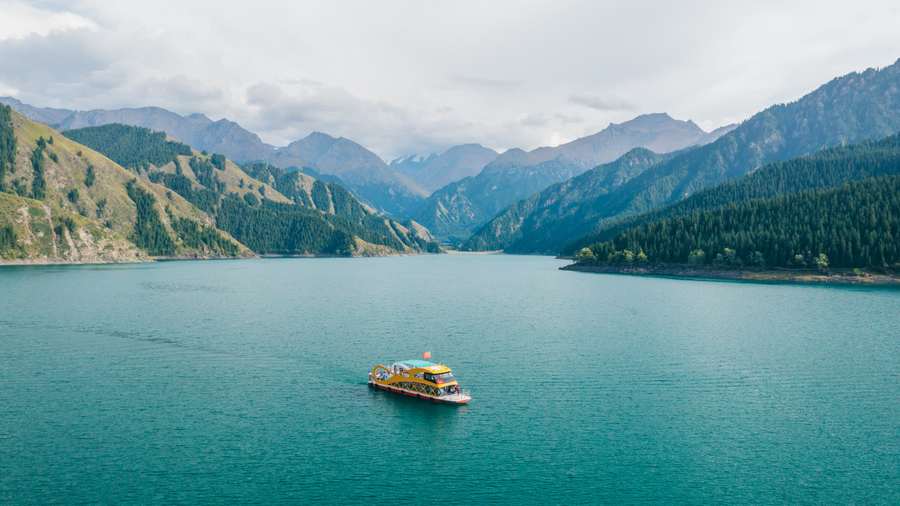
Heavenly Lake. A lake at 1,900 m under Bogda Peak south of Fukang, 4.9 square kilometres of deep blue ringed by spruce with a 5,000 m summit behind. Entry ninety-five yuan plus ninety for the shuttle; private cars cannot enter, and the bus takes forty minutes. The loop boardwalk takes two hours, or take a boat to the Xiwangmu temple. August shore temperature is around 20 C, the coolest place near Urumqi. Arrive before eight to beat the queues.
Dingshen Zhen. A single ancient elm on the north shore of Heavenly Lake, said to be over a thousand years old, standing alone at the water's edge with red cloth strips tied to its branches by worshippers. It is a few minutes from the start of the loop boardwalk, so no detour is needed, and there is an information board with the legend. Do not climb the tree or pull the strips. Wind off the lake takes hats and paper quickly.
East Small Heavenly Lake. A small emerald lake in the valley east of Heavenly Lake, fed by water seeping underground from the main lake, ringed by dense forest with a waterfall, and far quieter than the main shore. Thirty minutes east along the boardwalk, with steps. The waterfall drops over thirty metres and the spray soaks camera lenses. The valley floor is wet and slippery, so wear grip.
Road note: Two or three hours of driving with service areas and towns in between, so there is no need to rush.
Eat: Urumqi has the widest choice of restaurants in Xinjiang, from banmian noodles to big-plate chicken, around 50 CNY per person.
Sleep: Hotels run 150 to 500 CNY with easy parking.
Tip: Rush hour is heavy; fill the tank before leaving the city.
Tickets and opening hours
| Site | Ticket | Hours |
|---|---|---|
| Gurbantonggut Desert | See ticket office | Check the gate on the day |
| Kalamaili Reserve | See ticket office | Check the gate on the day |
| Kekesuli | See ticket office | Check the gate on the day |
| Irtysh River | See ticket office | Check the gate on the day |
| Pit No. 3 | See ticket office | Check the gate on the day |
| Altay Grasslands | See ticket office | Check the gate on the day |
| Fuhai and Ulungur Lake | See ticket office | Check the gate on the day |
| Jiadengyu | See ticket office | Check the gate on the day |
| The Three Bays | See ticket office | Check the gate on the day |
| Kanas Lake | See ticket office | Check the gate on the day |
| Hemu River | See ticket office | Check the gate on the day |
| Birch Groves | See ticket office | Check the gate on the day |
| Hemu Village | See ticket office | Check the gate on the day |
| Hemu Viewing Platform | See ticket office | Check the gate on the day |
| Grassland Sections | See ticket office | Check the gate on the day |
| Urho Ghost City | See ticket office | Check the gate on the day |
| Karamay Oil Field | See ticket office | Check the gate on the day |
| Heavenly Lake | See ticket office | Check the gate on the day |
| Dingshen Zhen | See ticket office | Check the gate on the day |
| East Small Heavenly Lake | See ticket office | Check the gate on the day |
Tickets and shuttle buses are priced separately and change with season and holidays, so confirm at the gate; guides, horses and boats are extra.
Six things to know on the road
- Foreign vehicles must be declared to customs by a licensed travel agency. Private cars cannot clear the border on their own; that is the procedure, not an option.
- The temporary plate is valid three months. Do not change the route filed at entry without re-filing it.
- Some frontier districts in Xinjiang need prior approval, and Xinjiang to Tibet cannot be crossed directly: you must go around via Golmud on the G109.
- Fuel is sold against ID, so keep the vehicle registration and licence within reach; stations can be 200 km apart.
- Speed limits differ sharply between expressway and national road, and average-speed cameras are everywhere, so slow down at every sign.
- At checkpoints, slow early and hand over passport, licence, registration and temporary plate together in one folder.
When to come
For Kanas and Hemu, June is green and late September to early October is the birch peak, which is also the busiest and most expensive window. July is wet, and from late October snow closes the high sections. Mid-June and late August are the two quieter gaps.
How to extend it
The simplest extension is one more night at Gurbantonggut Desert, so the next day needs no driving and you can add a side valley or village. You can also link this to the other half of the Duku highway, or exit at Horgos into Kazakhstan, though both need a new route filing, so tell us in advance.
Contact and quote
This route can be adjusted to your dates, group size and vehicle. The quote covers customs declaration, temporary plate, route filing and port handling, and excludes fuel, tickets, rooms and meals. Send the port and date you plan to enter and we will confirm what is workable under the current rules.
WhatsApp: +86 13759155671 Email: [email protected]