Who this route suits
14 days and 3,460 kilometres through The Dabancheng Wind Gap, Flaming Mountains, Grape Valley, Karez Wells. Fourteen days climb from Turpan and Hami in the east up to Altay, adding Tianchi on the return, so the Flaming Mountains and Kanas snow sit on one line. Fuel, hotels and supplies are laid out day by day below, and the pace can be adjusted to your own energy.
How the foreign vehicle comes in
The Xinjiang gateway is Horgos on the Kazakh border. Foreign vehicles must be declared to customs by a licensed agency; private cars cannot clear on their own. The service fee is 6,000 to 9,000 CNY per vehicle, covering customs declaration, border formalities, the Chinese temporary driving permit, the temporary plate (valid three months), route filing and on-site handling at the port. The customs deposit is guaranteed by us, after which the owner pays 10,000 CNY, refunded in full three to five working days after leaving China. Documents are due 20 days ahead: passport, Chinese visa, driving licence, passport photo of the driver on a white background, vehicle registration, title, engine number, and front, rear and side photos of the car; vehicles over six years old also need a roadworthiness certificate.
Route overview
The route runs 3,460 kilometres in 14 days, 247 kilometres a day on average, with 14 driving days and 0 stay days. It starts and ends in Urumqi, and the daily stages and main stops are listed below.
| Day | Stage | KM | Main stops |
|---|---|---|---|
| 1 | Urumqi → Turpan | 190 km | The Dabancheng Wind Gap, Flaming Mountains, Grape Valley, Karez Wells |
| 2 | Turpan → Hami | 420 km | Shanshan, Kumtag, a long desert run |
| 3 | Hami → Barkol | 130 km | Tianshan temple, Balikun Lake, Balikun Old Town |
| 4 | Barkol → Hami | 130 km | the northern Tianshan slope, The Barkol grassland |
| 5 | Hami → Turpan | 420 km | Shanshan, The hundred-mile wind zone |
| 6 | Turpan → Urumqi | 190 km | The Dabancheng Wind Gap, Yanhu Salt Flats |
| 7 | Urumqi → Fuyun | 480 km | the eastern Gurbantunggut, Kalamaili Reserve |
| 8 | Fuyun → Burqin | 330 km | Altay Grasslands, Fuhai |
| 9 | Burqin → Kanas | 150 km | Jiadengyu, the valley gate, The Three Bays, Moon Bay, Kanas Lake |
| 10 | Kanas → Hemu | 70 km | Hemu River, Birch Groves, Hemu Village |
| 11 | Hemu → Burqin | 160 km | the Hemu viewpoint at dawn, Grassland Sections |
| 12 | Burqin → Urho | 230 km | Irtysh valley, Urho Ghost City |
| 13 | Urho → Urumqi | 420 km | The Karamay oil belt |
| 14 | Urumqi → Tianchi → Urumqi | 140 km | Tianchi, Dingshen Zhen, East Tianshan pond |
Day by day
1 Urumqi → Turpan (190 km)
The Dabancheng Wind Gap.The gap between the Tianshan and Bogda ranges where wind blows nearly every day of the year — the windbreak walls and ranks of turbines along the road say so without words. At 190 km it is a short hop: leave mid-morning and you are in Turpan for lunch, with the whole afternoon for the trio on the city's doorstep. Do the Karez wells first to learn where the water comes from, hide in Grape Valley over the hot hours, and save the Flaming Mountains for after four, when the ground has cooled enough to stand on. Crosswind through the gap is honest and steady; keep room around trucks and take it gently.
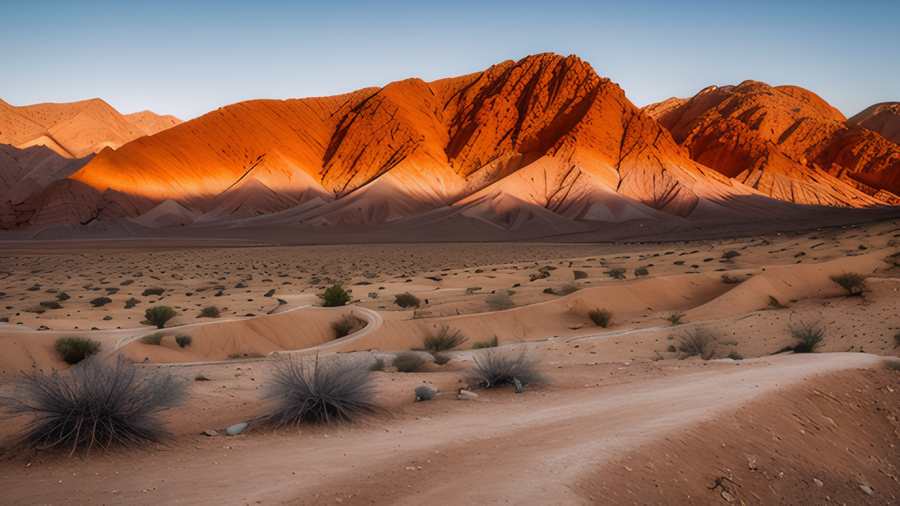
Flaming Mountains.The Flaming Mountains run east–west along the G312 northeast of Turpan city, 98 km long and up to 10 km wide, built of red sandstone that in summer sun looks like heated iron. The Journey to the West story of Tripitaka crossing the Flaming Mountains made the place famous. The scenic area sits at the foot of the range; its landmark is the giant golden-cudgel thermometer, and at midday in high summer the ground temperature passes 70°C while the gauge often reads in the sixties. Ticket CNY 40, open 8:00–20:00 in summer. The strong hour is late afternoon, when slanting light picks out the ridges one by one; at noon it is a wall of glare.
Grape Valley.Grape Valley lies in a gorge on the western side of the Flaming Mountains, 8 km north–south and about 2 km wide, with the Buyiluke river running through it and trellises of vines on both sides. Outside is bare red rock; inside is shade, running water and air 3–5°C cooler than the city — the "emerald in the fire continent". Nearly a hundred varieties grow here, from seedless white to mare's nipple and red rose, a living grape museum. It became a national 5A scenic area in 2007. Ticket CNY 60, open 8:00–20:00. Inside are the Grape Valley amusement park, the Wang Luobin music hall, the Darwaz folk park, the Afanti park and Frog Lane; allow two to three hours.
Karez Wells.Turpan's two-thousand-year-old underground water system, carrying Tianshan meltwater through tunnels to the oasis, with vertical shafts marking the line across the plain. The Karez park on the city edge charges around 40 CNY and lets you walk down into a tunnel with water at your feet. It is cool and dim below, and the steps are wet. Working karez shafts are still visible along the roads; the whole oasis depends on them. Pull-offs are few, so take the marked ones and avoid stopping on the shoulder. There are no shops nearby, so stock water and snacks at the previous stop.
Road note:Two or three hours of driving with service areas and towns in between, so there is no need to rush.
Eat:Urumqi has the widest choice of restaurants in Xinjiang, from banmian noodles to big-plate chicken, around 50 CNY per person.
Sleep:Yuli county hotels 130 to 250 CNY; a riverside guesthouse around 200 CNY.
Tip:Mosquito repellent at dusk in summer; in October, a jacket for the evening.
These are the first days of a foreign-vehicle run in Xinjiang, so fill the tank before leaving town; stations are further apart than they look.
2 Turpan → Hami (420 km)
Shanshan.Shanshan sits in the east of the Turpan basin at the northern edge of the Kumtag Desert, the last proper town before the dunes on this route. It is a one-street place with rooms at one to two hundred yuan and cheap noodles, kebabs and pilaf; in July and August grapes and hami melons come in and are sold by the kilo at the roadside, almost too sweet. A few kilometres south is the desert park, west are Tuyugou and the Flaming Mountains, east the road to Hami. Fill the tank before leaving, since stations thin out eastwards. The town sits at six hundred metres and is hot in summer, so keep activity to the early and late hours.
Kumtag.The desert at the edge of Shanshan town, dunes rising straight from the built edge, one of the few places where a city sits against a great sand sea. Ticket plus shuttle, and a boardwalk to the first ridge. The dunes reshape daily and yesterday tracks may be gone today. The desert burns by day and cools at night; sunrise and sunset are the two hours worth keeping. The day covers 320 km, cut into two-hour blocks with lunch in a town en route. Middle of the day gives hard light, so early morning and late afternoon are worth the extra time.
a long desert run.The long desert stretches between eastern Xinjiang and Junggar, straight road and few landmarks, tiring to drive. Stop every two hours, swap drivers or walk a few steps. The surface is good and the speed signs are far apart; it is easy to drift fast, so slow down at every village. The day covers 320 km, cut into two-hour blocks with lunch in a town en route. The altitude here is higher than in town, so walk slower for the first hour after leaving the car. Wind picks up fast, so keep a cap and a light jacket handy and hold the door when opening it.
Road note:Three and a half hours east on the G3012, straight and fast with service areas.
Eat:Shanshan: roast lamb and cold noodles, 40 CNY; melon from the roadside in season.
Sleep:Same hotel in Shanshan, 130 to 250 CNY.
Tip:Keep the cooling system checked: the basin is brutal on engines in summer.
These are the first days of a foreign-vehicle run in Xinjiang, so fill the tank before leaving town; stations are further apart than they look.
3 Hami → Barkol (130 km)
Tianshan temple.A small temple on the pass road north of Hami, rebuilt on an old site, with a spring and a view back over the desert. Free or a token fee; half an hour is enough. The rooms are small and queues build, so the first session of the day is the calmest. Flashes are banned in most caves and ruins, so read the signs before shooting, and guides are charged per group. Opening days change between seasons, so confirm the closing day at the gate before driving out. Weather turns quickly and cloud brings a chill, so keep a jacket within reach in the car.
Balikun Lake.A highland salt lake northwest of Balikun town, several dozen square kilometres of water ringed by salt flats and meadow, with migratory birds in summer and the eastern Tianshan snow behind. There is a boardwalk and platform, entry modest. At 1,600 m the wind is constant and the lake turns red at sunset. Salt flats are soft, so do not walk onto them. Twenty minutes from town. Wind on the shore is strong, so keep a jacket in the car; the loop road is slow and the marked pull-offs are the only safe stops. The water shifts colour with the weather, grey under cloud and blue-green in sun, so an early start or a late stop gives the better light.
Balikun Old Town.A Qing military town on the eastern Xinjiang frontier with its rammed-earth walls still standing for several kilometres, plus old lanes, a Dizang temple and a Niangniang temple. The wall walk is free and the brick carvings over the old doorways are worth a look. The town is small enough to cover on foot. Lamb stewed with pancake and local yoghurt are the specialties at 40 to 50 CNY per head. The bazaar is busiest in the morning and empties after lunch, so shop early and start the bargaining low. Fuel, cash and supplies sit on the main street, so clear all three before leaving town.
Road note:Two hours east on paved county road, empty and fast.
Eat:River fish and lamb at the forest gate, 50 CNY; noodles in town, 25 CNY.
Sleep:Kashgar hotels 150 to 350 CNY.
Tip:The pass is cold even in summer: carry a jacket for the climb.
These are the first days of a foreign-vehicle run in Xinjiang, so fill the tank before leaving town; stations are further apart than they look.
4 Barkol → Hami (130 km)
the northern Tianshan slope.The meadow and spruce belt of the northern Tianshan, running west from Urumqi towards Ili, snowmelt feeding a string of oasis cities. Altitude stays modest and the scenery is the road itself. Rain arrives fast and mountain streams rise fast, so keep out of the side valleys in the afternoon. Grassland and valley open out for miles, and herders move sheep across the road, so slow as soon as you see them. The day covers 130 km, short enough to stop whenever something looks worth it. Walk slowly here; the good viewpoints are spread out and there is no need to crowd the gate.
The Barkol grassland.A high grassland on the northern slope of the Eastern Tianshan, quieter than its Ili cousins, where barley fields and rapeseed stitch into the pasture and sheep scatter across easy slopes. The 130 km back over the pass go well in the morning, when eastern light lies flat across Barkol Lake — circle the lake before climbing. In the old town, Qing-dynasty granaries and the garrison walls are worth half an hour, and cold noodles with chicken is the local plate. Downhill grades are long; brake early in a low gear, then find flat ground and let the brakes cool before pressing on.
Road note:An hour north on paved road, flat and signed.
Eat:Noodles and grilled meat in the towns along the way, around 40 CNY.
Sleep:Horgos hotels 150 to 300 CNY.
Tip:Keep the customs papers in the room safe, not in the car, while you walk the market.
Watch the GPS and the fuel gauge together out here, and do not count on the next station.
5 Hami → Turpan (420 km)
Shanshan.Shanshan sits in the east of the Turpan basin at the northern edge of the Kumtag Desert, the last proper town before the dunes on this route. It is a one-street place with rooms at one to two hundred yuan and cheap noodles, kebabs and pilaf; in July and August grapes and hami melons come in and are sold by the kilo at the roadside, almost too sweet. The county town is one main street, with fuel, repairs and groceries all on it. Hotels cluster along the main street, and the closer to the centre the easier the parking. A ticket is valid for the day, so do not leave anything in the car if you plan to come back in.
The hundred-mile wind zone.The gobi wind belt between Hami and Turpan, where around Shisanjianfang force-eight winds blow on a hundred days a year and trucks park in convoys to wait them out. Treat the 420 km as the day's sight: turbine walls run past the window without end, and in the parking bays hold the door firmly — the wind here genuinely fights you for it. Winds ease around midday, so time the run to that window. When a gust arrives it comes without scenery to warn you: slow first, correct after, both hands on the wheel, and never sit alongside a truck.
Road note:Two hours south-east on the G3012, straight and easy.
Eat:Fukang: lamb noodles, 35 CNY; at the lake, simple meals 40 to 60 CNY.
Sleep:Same hotel at the gate, 200 to 450 CNY.
Tip:Fill up before the mountain: the gate has no fuel.
Watch the GPS and the fuel gauge together out here, and do not count on the next station.
6 Turpan → Urumqi (190 km)
The Dabancheng Wind Gap.The gap between the Tianshan and Bogda ranges where wind blows nearly every day of the year — the windbreak walls and ranks of turbines along the road say so without words. At 190 km it is a short hop: leave mid-morning and you are in Turpan for lunch, with the whole afternoon for the trio on the city's doorstep. On long days, break the drive every two hours and eat lunch in a town along the way. Speed limits change quickly around passes and tunnels, so slow down when you see the sign. Avoid driving at night, as livestock and motorbikes appear on the road without warning.
Yanhu Salt Flats.A dry salt basin between Urumqi and Turpan where the ground is crusted white and looks snow-covered from a distance. A small scenic area allows walking on the crust for a few dozen yuan, and people photograph reflections. The basin is extremely hot in summer with ground temperatures near 60 C. The crust edge is soft, so do not wander far. Wind takes hats. The water shifts colour with the weather, grey under cloud and blue-green in sun, so an early start or a late stop gives the better light. The lake sits higher than the city and the air is thinner, so take the first hour slowly and skip the steep climb right after parking.
Road note:Three hours west on the G30, fast with heavy truck traffic.
Eat:Yining is known for pepper chicken, meatball soup and pilaf, around 50 CNY near Liuxing Street.
Sleep:Rooms 120 to 250 CNY.
Tip:Performances run to a fixed schedule, so confirm times before going.
Watch the GPS and the fuel gauge together out here, and do not count on the next station.
7 Urumqi → Fuyun (480 km)
the eastern Gurbantunggut.The fixed and semi-fixed sand of the Junggar basin, its eastern edge near Qitai and Mulei, covered in saxaul and tamarisk rather than the shifting dunes of the Taklamakan. It snows in winter and the grass is short in summer. The desert burns by day and cools at night; sunrise and sunset are the two hours worth keeping. The day covers 480 km, cut into two-hour blocks with lunch in a town en route. There are no landmarks on the gobi, so watch the map and the fuel gauge together and avoid standing out at midday. Sand and salt crust are soft at the edges, so stay in the existing tracks; a stuck car is hard to recover here.
Kalamaili Reserve.The largest ungulate reserve in Xinjiang, on the eastern Junggar basin, where wild asses, gazelles and argali run across open desert and herds sometimes cross the highway. Warning signs line the reserve edge; slow down and never sound the horn at animals. Fuel stations are far apart, so carry water and fill up. Summer is brutally hot, winter brings snow, spring and autumn are the strong seasons. Pull-offs are few, so take the marked ones and avoid stopping on the shoulder. There are no shops nearby, so stock water and snacks at the previous stop. Time here can stretch or shrink with the light and your energy, so there is no need to chase the next stop.
Road note:Five hundred kilometres or so, with stretches of open desert, so keep water and food within reach.
Eat:Noodles and grilled lamb in Baicheng, 35 CNY; a simple lunch at the caves car park, 30 CNY.
Sleep:Same hotel in Baicheng, 130 to 220 CNY.
Tip:If you plan the Subashi ruins, go in the morning: there is no shade at midday.
Halfway through: check tyre pressures and washer fluid, with plenty of road still ahead.
8 Fuyun → Burqin (330 km)
Altay Grasslands.The northernmost summer pasture belt in Xinjiang, spread along the roads out of Altay towards Fuyun and Burqin. Grass does not green up until June and peaks in July and August, with sheep and horse herds scattered across the slopes and the Altai snow line behind. Nothing is fenced off; the scenery is the road itself. Farm tracks are open but do not drive on pasture or chase stock. Mobile signal is patchy, so download offline maps. Mosquitoes are active on the grassland, so carry long sleeves and repellent, and keep the car off soft meadow after rain. Herds cross the road without warning, so slow down early and never sound the horn at animals.
Fuhai.A county town south of Altay beside Ulungur Lake, known for winter fishing and fish dinners. It is small, with Burqin to the north and Keketuohai east. Most boardwalks and viewpoints sit on the sheltered side; the light is strong half an hour before sunset. In high season the car park sits far from the gate, and arriving early saves a long walk. The day covers 330 km, cut into two-hour blocks with lunch in a town en route. Pull-offs are few, so take the marked ones and avoid stopping on the shoulder. There are no shops nearby, so stock water and snacks at the previous stop.
Road note:Short runs only; do not attempt the desert tracks east without a guide.
Eat:Food street: grilled lamb, pilaf, melon, 35 to 50 CNY.
Sleep:Turpan hotels 150 to 300 CNY.
Tip:Fill up before leaving Kashgar; the forest turn has no station nearby.
Halfway through: check tyre pressures and washer fluid, with plenty of road still ahead.
9 Burqin → Kanas (150 km)
Jiadengyu, the valley gate.The gateway to Kanas, with the visitor centre and shuttle interchange, private cars parked outside. One valley leads to the lake, another to Hemu, and the two split here. This is the last place to top up fuel, water and cash; choices thin out badly beyond here. The day covers 150 km, short enough to stop whenever something looks worth it. Pull-offs are few, so take the marked ones and avoid stopping on the shoulder. There are no shops nearby, so stock water and snacks at the previous stop. Time here can stretch or shrink with the light and your energy, so there is no need to chase the next stop.
The Three Bays.Wolong Bay, Moon Bay and Shenxian Bay are three bends of the Kanas River, each with a shuttle stop. Wolong has a wide pool with a sandbar in the middle and a short path down to the water. Moon Bay is the photogenic one, a crescent peninsula wrapped by blue-green water, seen straight from the roadside platform with no walking. Shenxian Bay holds fog until about eight in the morning. Walking the whole boardwalk takes two hours downhill. Pull-offs are few, so take the marked ones and avoid stopping on the shoulder. There are no shops nearby, so stock water and snacks at the previous stop.
Moon Bay.Moon Bay is a bend of the Kanas River that curls almost closed, shaped like a crescent, with larch and spruce on both banks. A boardwalk follows the river downstream from Kanas village and links Wolong Bay, Moon Bay and the Fairy Bay in one walk. Mist sits on the water at dawn, and the minutes when it lifts give the richest colour. Late September turns the forest yellow against deep green water. The boardwalk rises and falls, and the full walk takes two to three hours, so wear soft shoes. The stone by the water is slippery, so stay behind the railing.
Kanas Lake.A glacial lake deep in the Altai Mountains, its water shifting colour with the season and the light, ringed by Tuvan villages that have stood by the shore for centuries. Jiadengyu is the gate: in season private cars park at the transfer centre and the valley is entered by shuttle. The three bays — Wolong, Moon and Fairy — line up on one route, fine from the road, though the boardwalks reward an hour on foot. The 150 km drive takes barely three hours, so keep your legs for the lakeside. The Guanyu Pavilion means a thousand-plus steps and is worth it only if you have time to spare.
Road note:Three hours south-west; the last hour is open gobi with crosswind.
Eat:Kashgar: polo, kebabs, baked buns, 40 to 60 CNY around the old city.
Sleep:Barkol hotels 130 to 250 CNY; yurts at the lake 150 to 300 CNY.
Tip:Watch for sheep on the road at dusk; herders move them across without warning.
Halfway through: check tyre pressures and washer fluid, with plenty of road still ahead.
10 Kanas → Hemu (70 km)
Hemu River.Glacial meltwater runs straight through the village, cold even in August, over a bed of rounded stones. The riverside boardwalk reaches Hemu Bridge in about twenty minutes, and the bridge is the classic angle: birch on one bank, spruce on the other, both turning gold in late September and October. A few stalls sell grilled fish and milk tea. The track deeper towards Meili Peak is rough and not for sedans. The river runs muddy in summer and clears in autumn; never drive down onto the bed. Damp valley air brings morning fog, so wait for it to lift before setting off.
Birch Groves.Birch is the main event of a northern Xinjiang autumn: white trunks you can peel in layers, leaves turning from late September, peak in early October, one gust and the ground is gold. Groves line the road from Burqin to Jiadengyu, the Hemu village entrance and the Kanas outlet, so no special stop is needed. Light inside the grove is soft, which suits overcast days. Mosquitoes are dense in summer, so cover up and bring repellent. Light is dim under the trees and wet leaves are slippery, so walk slowly and leave lighters behind. The yellow-leaf window on birch and poplar lasts only two or three weeks, green early and bare late.
Hemu Village.The last road-accessible village inside the Kanas reserve, where Tuvan families still live in log cabins with pitched roofs along the Hemu River. Cars stop at the gate and shuttle buses take you in. Walk twenty minutes up the wooden steps behind the village before dawn and the whole valley sits below you, smoke rising from the roofs and mist drifting over the water. Beds run from around 100 CNY to 700 CNY a night in season. Old-town lanes are narrow, so park in the outer lot and walk in, and ask before taking portraits. The bazaar is busiest in the morning and empties after lunch, so shop early and start the bargaining low.
Road note:A short run of an hour or two, with a stop or two on the way and no need to hurry.Ili is wet, the surface is slick, so brake early and never carry speed through a bend.
Eat:Kuqa bazaar: baked buns, kebabs, dried apricots, 40 CNY.
Sleep:Shanshan hotels 130 to 250 CNY.
Tip:Do not leave the car in the sun with water bottles inside: they get hot enough to burn.
By this stage car and driver are settled in, which is exactly when it pays to keep the speed down.
11 Hemu → Burqin (160 km)
the Hemu viewpoint at dawn.The terrace behind Hemu village, climbed at dawn to look down on the whole settlement, log roofs, hearth smoke and mist spreading through the valley. Be there half an hour before sunrise; the platform fills once the sun is up. Grassland and valley open out for miles, and herders move sheep across the road, so slow as soon as you see them. The day covers 160 km, short enough to stop whenever something looks worth it. There are no shops nearby, so stock water and snacks at the previous stop. Pull-offs are few, so take the marked ones and avoid stopping on the shoulder.
Grassland Sections.Two kinds of grassland: the humid Ili and Altay pastures with knee-high grass, spruce and wildflowers, and the high pastures of Bayanbulak and Balikun above 2,000 m, short but vast. Driving here means watching for livestock, which cross unmarked and appear in groups at blind bends, and never driving off the road onto grass, where wetland or animal burrows can swallow a wheel. Days are hot and evenings cold, so a thick jacket in the boot covers both. Mosquitoes are active on the grassland, so carry long sleeves and repellent, and keep the car off soft meadow after rain. Herds cross the road without warning, so slow down early and never sound the horn at animals.
Road note:Two and a half hours north, climbing to the pass then down into the basin.
Eat:Bachu: roast lamb, pilaf and cold noodles, 40 to 60 CNY.
Sleep:Same hotel in Bachu, 130 to 250 CNY.
Tip:Do not arrive in the old city by car: park outside and walk the lanes.
By this stage car and driver are settled in, which is exactly when it pays to keep the speed down.
12 Burqin → Urho (230 km)
Irtysh valley.The only Chinese river draining to the Arctic, coming off the Altay and running west through poplar, willow and marsh. The Burqin to Habahe stretch is the prettiest, water and leaves changing colour together in autumn. Most boardwalks and viewpoints sit on the sheltered side; the light is strong half an hour before sunset. The day covers 230 km, short enough to stop whenever something looks worth it. The river runs muddy in summer and clears in autumn; never drive down onto the bed. Damp valley air brings morning fog, so wait for it to lift before setting off. Valley roads bend often, with loose rock on the hill side and no barrier on the water side, so keep the speed down.
Urho Ghost City.A yardang field about 100 km north of Karamay, eroded into castles, mushrooms and beasts across tens of kilometres, where wind through the gullies makes the whistling that gave the place its name. A tourist train loops four or five stops in ninety minutes, and boardwalks link the viewpoints. The last hour before sunset turns the rock red and stretches the shadows. Summer midday hits 50 C with sand-laden wind, so protect cameras. Service areas are widely spaced, so use fuel and toilets at the same stop. Walk slowly here; the good viewpoints are spread out and there is no need to crowd the gate.
Road note:An hour north on paved road, flat and signed.
Eat:Noodles and grilled meat in the towns along the way, around 40 CNY.
Sleep:Horgos hotels 150 to 300 CNY.
Tip:Keep the customs papers in the room safe, not in the car, while you walk the market.
By this stage car and driver are settled in, which is exactly when it pays to keep the speed down.
13 Urho → Urumqi (420 km)
The Karamay oil belt.South of Urho the pumpjacks march across the desert to the horizon, pipelines and storage tanks in continuous blocks — one of the few places in China where the highway runs straight through an oilfield. Drones are banned here, so read the signs before flying anything. The 420 km make a full day: leave in the cool of the morning, eat and refuel in Karamay city at midday, and top up at every station because services thin out between towns. The wind-prone sections after lunch push trucks sideways; keep distance and finish overtakes in one clean move. Urumqi comes up by early evening, in time for a rest before the eastern leg begins.
Road note:No driving; shuttle and walking only.
Eat:Lake fish – grilled, stewed or in soup – 50 to 80 CNY at the beach restaurants.
Sleep:Same guesthouse by the lake, 150 to 350 CNY.
Tip:Rinse the car before leaving the lake area: salt and sand stick to the paint.
The last days: keep permits, the temporary plate and receipts in one folder for the border.
14 Urumqi → Tianchi → Urumqi (140 km)
Tianchi.Tianchi sits below Bogda Peak south of Fukang at about 1,900 metres, a long narrow lake against snow and spruce. Shuttles climb to it, and the lakeside boardwalk takes about two hours around. Most boardwalks and viewpoints sit on the sheltered side; the light is strong half an hour before sunset. The day covers 140 km, short enough to stop whenever something looks worth it. The water shifts colour with the weather, grey under cloud and blue-green in sun, so an early start or a late stop gives the better light. The lake sits higher than the city and the air is thinner, so take the first hour slowly and skip the steep climb right after parking.
Dingshen Zhen.A single ancient elm on the north shore of Heavenly Lake, said to be over a thousand years old, standing alone at the water's edge with red cloth strips tied to its branches by worshippers. It is a few minutes from the start of the loop boardwalk, so no detour is needed, and there is an information board with the legend. Do not climb the tree or pull the strips. Wind off the lake takes hats and paper quickly. Read the signs on photography and put the phone away where shooting is banned, as staff will say so directly. With children or older travellers, put this stop in the morning, when crowds are thin and the light is soft.
East Tianshan pond.A smaller lake below the main one, reached on a stepped path through spruce, with a waterfall between the two. Quieter than the main shore. Wind on the shore is strong, so keep a jacket in the car; the loop road is slow and the marked pull-offs are the only safe stops. The water shifts colour with the weather, grey under cloud and blue-green in sun, so an early start or a late stop gives the better light. The lake sits higher than the city and the air is thinner, so take the first hour slowly and skip the steep climb right after parking.
Road note:One and a half hours north-west on the G3012 and county road.
Eat:Lake restaurants: trout, noodles, 50 to 70 CNY.
Sleep:Urumqi hotels 150 to 400 CNY.
Tip:There is no supply in the desert, so carry water, fuel and offline maps.
The last days: keep permits, the temporary plate and receipts in one folder for the border.
Tickets and opening hours
| Spot | Ticket | Opening |
|---|---|---|
| The Dabancheng Wind Gap | Free | As posted at the site |
| Flaming Mountains | About CNY 45 | As posted at the site |
| Grape Valley | About CNY 75 | As posted at the site |
| Karez Wells | About CNY 40 | As posted at the site |
| Shanshan | Free | As posted at the site |
| Kumtag | As posted at the site | As posted at the site |
| a long desert run | As posted at the site | As posted at the site |
| Tianshan temple | As posted at the site | As posted at the site |
| Balikun Lake | As posted at the site | As posted at the site |
| Balikun Old Town | As posted at the site | As posted at the site |
| the northern Tianshan slope | Tickets at the gate | As posted at the site |
| The Barkol grassland | As posted at the site | As posted at the site |
| The hundred-mile wind zone | Tickets at the gate | As posted at the site |
| Yanhu Salt Flats | About CNY 40 | As posted at the site |
Prices are indicative and change in peak season and at holidays; always check the posted rate. Shuttles, guides, horse hire and boats are charged separately.
Six things to know on the road
- Foreign vehicles must be declared to customs by a licensed travel agency. Private cars cannot clear the border on their own; that is the procedure, not an option.
- The temporary plate is valid three months. Do not change the route filed at entry without re-filing it.
- Some frontier districts in Xinjiang need prior approval, and Xinjiang to Tibet cannot be crossed directly: you must go around via Golmud on the G109.
- Fuel is sold against ID, so keep the vehicle registration and licence within reach; stations can be 200 km apart.
- Speed limits differ sharply between expressway and national road, and average-speed cameras are everywhere, so slow down at every sign.
- At checkpoints, slow early and hand over passport, licence, registration and temporary plate together in one folder.
When to come
April to October works, July and August roast the east so drive early and late, and September suits the north.
How to extend it
To add time, stay an extra night in one town and keep the next day free for lanes or valleys you missed. For two or three more days it is better to cut a stage and slow the rest than to cram in more driving; any real change of direction needs the filed route updated.
Contact and quote
This route can be adjusted to your dates, group size and vehicle. The quote covers customs declaration, temporary plate, route filing and port handling, and excludes fuel, tickets, rooms and meals. Send the port and date you plan to enter and we will confirm what is workable under the current rules.
WhatsApp: +86 13759155671 Email: [email protected]